
Triathlon Fueling in Utah. Why Many Salt Lake Triathletes Still Under Eat Carbs on Race Day
If you train for triathlon in Utah, there’s a good chance you’re doing the work. Long rides through Emigration Canyon. Brick runs on the Jordan River Trail. Early morning pool sessions before work. Fitness is rarely the problem.
Fueling is.
Across Utah triathlons, from local sprint races to 70.3 and Ironman events, athletes are consistently under-fueling on race day. Recent endurance research shows that most athletes consume far fewer carbohydrates per hour than they plan. The result is predictable. Strong starts. Fading legs. Slower run splits.
Salt Lake Tri Club athletes see this every season. The bike feels controlled. The run turns into survival. This is not a pacing issue. It’s a fueling issue.
This post breaks down what current endurance nutrition research shows about carbohydrate intake, why Utah triathletes often fall short, and how to build a simple fueling plan that actually works for 70.3 and Ironman racing.
Fueling the Work. Why Most Endurance Athletes Still Under Eat Carbs on Race Day
You train for months. You dial in pacing. You sharpen transitions. Then race day hits, and your legs fade early. Most athletes blame fitness. The data says it’s usually carbs.
Recent studies show endurance athletes consistently eat far fewer carbs than they think during races. In real race conditions, marathoners average about 20 to 25 grams of carbs per hour. Cyclists average around 45 to 50 grams per hour. That is well below what the body can use during long events.
Another key point, for races lasting more than two hours, research still points to a practical target of 60 to 90 grams of carbs per hour. Some athletes can tolerate more. Most do not reach the minimum.
This gap matters. When muscle glycogen drops and blood glucose falls, pace drops with it. No mental toughness fixes that.
Real-life examples from the course
Example one. The strong biker who fades on the run (ME! Coach Duckworth lol)
You’ve seen this athlete. Okay swim. Great bike power. Then the run turns into survival mode by mile six. When you look at their fueling, it’s usually one bottle per hour with maybe one gel. That’s often 30 to 40 grams of carbs per hour on the bike. They start the run already low.
Example two. The disciplined age grouper who negative splits (Andrew Hall)
This athlete sets alarms. They fuel early. They fuel often. They take in carbs even when they don’t feel hungry. They hit 70 to 80 grams per hour on the bike and 50 to 60 grams per hour on the run. The result is steady energy and controlled pacing late in the race.
Example three. The athlete who trains low and races empty
Some athletes do fasted workouts or low carb training sessions. That can be useful in specific contexts. The mistake is racing the same way. Race day demands fuel. Training low does not mean racing low.
What the research keeps showing
Athletes underconsume carbs during races, even with a plan.
Actual intake is about 20 percent below plan.
Gels are often only partially consumed.
Anxiety, heat, and pacing mistakes reduce intake further.
The takeaway is simple. Your plan must be realistic and practiced. Not optimistic.
A simple carb framework that works
Forget perfection. Aim for consistency.
Before the race
Eat a carb-focused meal 3 to 4 hours before the start.
Target 2 to 3 grams of carbs per kilogram of body weight.
Keep fat and fiber low.
During the race
Start fueling early within the first 15 minutes.
Fuel on a schedule, not by feel.
Mix sources. Drink plus gels or chews.
Key conversion to remember
1 gram of carbohydrate equals 4 calories.
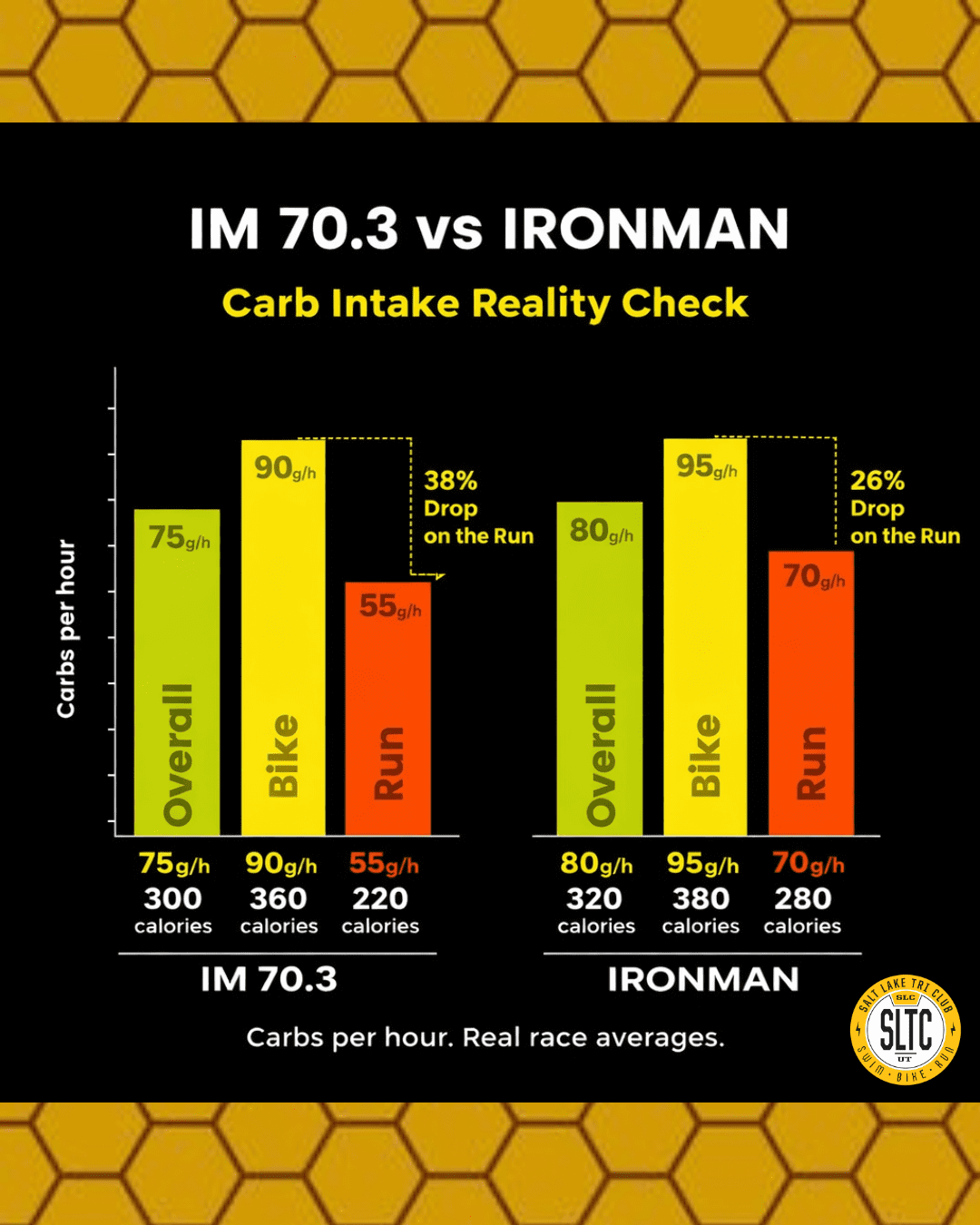
70.3 fueling example
Bike fueling target
70 to 90 grams of carbs per hour.
280 to 360 calories per hour.
Practical example
One bottle with 45 grams of carbs equals 180 calories.
One gel every 30 minutes at 25 grams each equals 50 grams and 200 calories.
Total per hour
95 grams of carbs.
380 calories.
This is aggressive but realistic for athletes who train it.
Run fueling target
50 to 70 grams of carbs per hour.
200 to 280 calories per hour.
Practical example
One gel every 30 minutes equals 50 grams and 200 calories.
Sports drink at aid stations can add another 10 to 20 grams if tolerated.
Total per hour
50 to 70 grams.
200 to 280 calories.
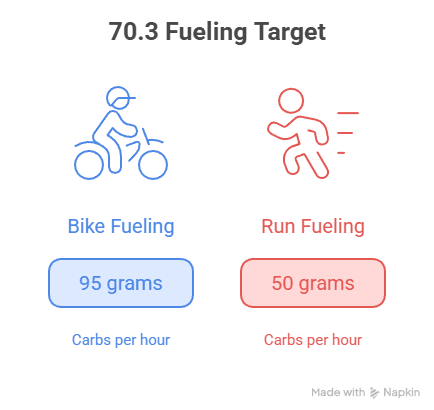
Ironman fueling example
Bike fueling target
80 to 100 grams of carbs per hour.
320 to 400 calories per hour.
Practical example
Two bottles per hour with 40 grams each equals 80 grams and 320 calories.
One gel per hour at 25 grams equals 100 calories.
Total per hour
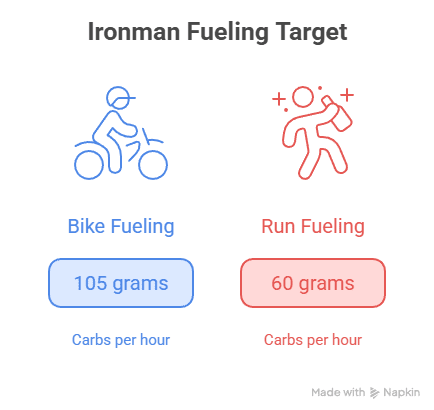
105 grams of carbs.
420 calories.
Many athletes will sit closer to 80 to 90 grams and 320 to 360 calories. The upper end is for well-trained guts only.
Run fueling target
40 to 60 grams of carbs per hour.
160 to 240 calories per hour.
Practical example
One gel every 30 minutes equals 50 grams and 200 calories.
Small sips of sports drink as conditions allow.
Total per hour
40 to 60 grams.
160 to 240 calories.
The goal on the Ironman run is steady intake, not catching up.
Training your gut is part of training
Carb intake is trainable. Just like fitness.
Practice race fueling on long rides and brick runs.
Use the same products you will race with.
Increase intake gradually over weeks.
Track grams per hour, not just calories.
Obviously, if you wait until race day to try a higher carb intake, you already lost.
Lastly, what does this mean for Salt Lake Tri Club athletes
If you are training consistently and still fading late, look at carbs first.
If your power and heart rate fall despite good pacing, look at carbs.
If your long rides feel fine but races fall apart, look at carbs.
Fitness sets the ceiling. Fueling determines whether you reach it.
Train hard. Fuel harder. Race smarter.
If you want help dialing this in, Coach Duckworth works with athletes every season to build race-specific fueling plans that match pacing, conditions, and gut tolerance. This is one of the fastest ways to improve race-day performance without adding more training hours.
Coach Duckworth

Other good reads on Endurance Nutrition:
https://www.triathlete.com/nutrition/endurance-athletes-racing-on-too-few-carbs-study/?link_source=ta_first_comment&scope=anon&taid=69324aca0a4f6e0001e3d28a&fbclid=IwY2xjawO-iQ5leHRuA2FlbQIxMABicmlkETFUMUVvbkpvZGZUQTBjall6c3J0YwZhcHBfaWQQMjIyMDM5MTc4ODIwMDg5MgABHi5Prg5fJ4YAEJ2wWFcTs-9y_0GhMafTxBEFA1y-otTjQkRqUNnTkf93Qge7_aem_SokLdrRx1FdKdbH4_Y9MOA
https://www.mdpi.com/2072-6643/17/5/918?